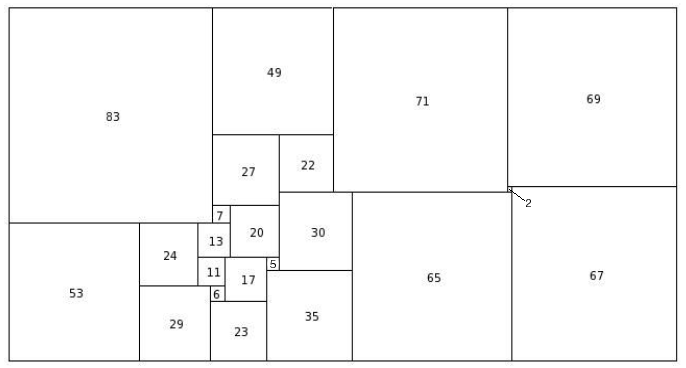
Simple squared rectangles were created and catalogued from the 1920s onwards in the search for a perfect squared square.
The first perfect squared rectangles were published by Zbigniew Moroń (Poland) in 1925. Michio Abe (Japan) published two papers on squared rectangles in the early 1930's and generated over 600 squared rectangles. After the publication of Sprague's squared square paper, and Brooks, Smith, Stone & Tutte's publication of 'The dissection of rectangles into squares', the search continued for the lowest order simple perfect squared square. It was certain that with the production of higher order squared rectangle catalogues, simple perfect squared squares would appear eventually. Originally these catalogues were calculated by hand but this changed when C.J. Bouwkamp, A.J.W. Duijvestijn and P. Medema pioneered the use of computers to automate the production of simple squared rectangle catalogues up to order 18 in the early 1960s.
The squared rectangles in order 9 to 21 on this website were created using S. Anderson's software
Squared rectangles have been divided into two main categories; simple perfects, with squares of all different sizes, and simple imperfects, with some squares of the same size. This classification supported the search for simple perfect squared squares.
Compound perfect squared rectangles (CPSRs) have also been produced in large numbers and catalogued by order. Bouwkamp also wrote about compound squared rectangles in 1960 and enumerated them by hand up to order 13. In 1999 Ian Gambini produced both compound (of the non-trivial kind) and simple squared rectangles up to order 24.
Squared Rectangles can be studied for their own intrinsic properties, which are interesting, and only partially explored and understood.
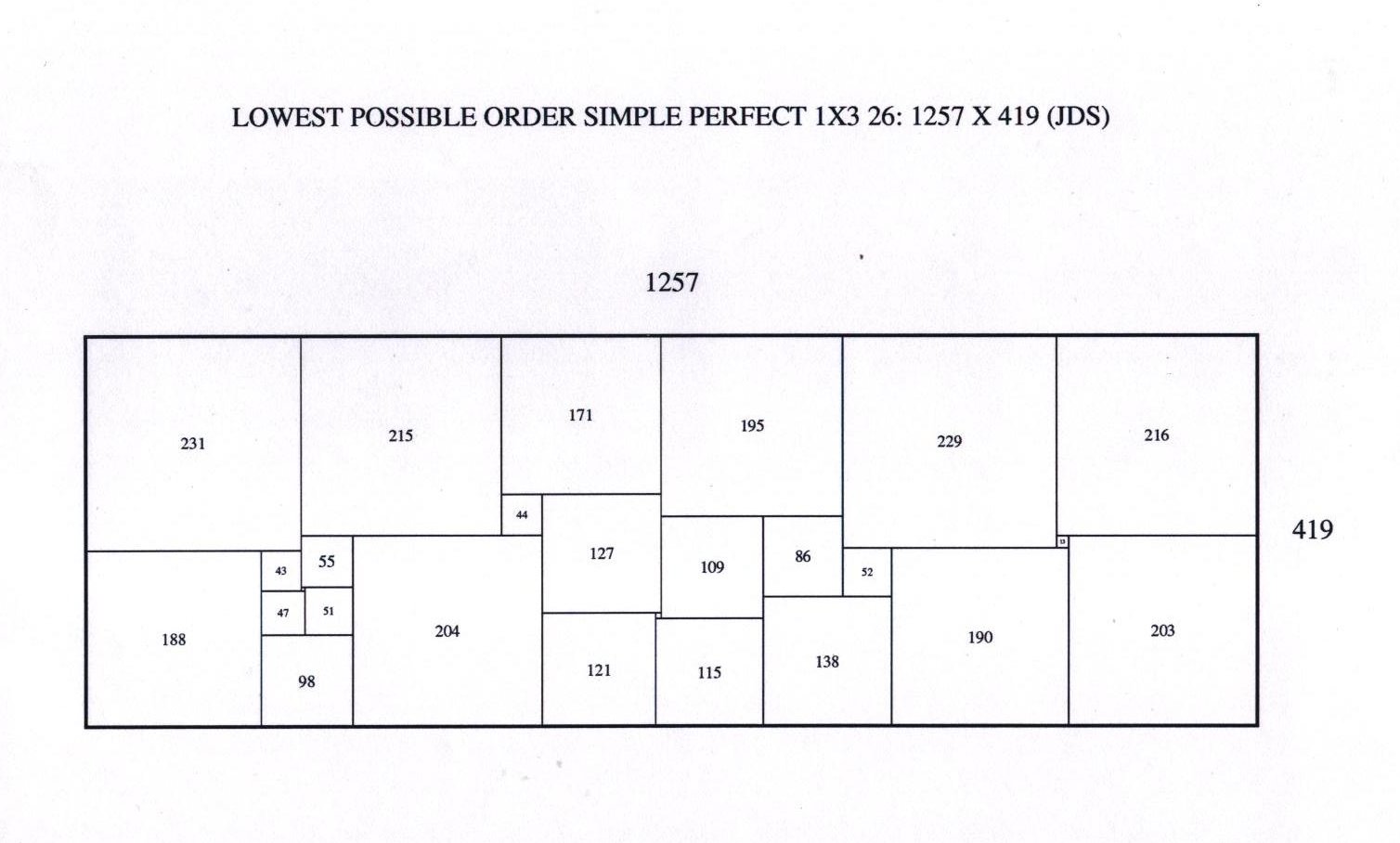
After the discovery of the lowest order SPSS by Duijvestijn in order 21. Attention turned to the lowest order squared domino (2:1 SPSR), which was not known at the time. This was subsequently found by Duijvestijn (order 22; 272 x 136) shortly after his discovery of the lowest order SPSS. Despite extensive computer searches the lowest order simple perfect squared rectangle (SPSR ) of many low integer aspect ratios are still yet to be found. A 3:1 simple perfect rectangle (the lowest order possible) has been found by Jasper Skinner in order 26.
It seemed that with current methods even a 4:1 SPSR would require a massive computational effort, equivalent to producing all squared squares and rectangles in the order 20's and possibly more. The usual method is to produce c-nets (3-connected planar graphs) and produce rectangles from them using the electrical network/squared rectangle theory, and filter them for rectangles of the form n:1. Given the frequency that 2:1 and 3:1 had occurred it seemed that the next missing 4:1 SPSR may not occur until the late 20's or even into the order 30's. The total number of squared rectangles even in the late 20's is quite large to search. Then an unexpected development occurred. Brian Trial of Ferndale, Michigan, U.S.A. developed new methods and has written new software and used it to discover many n:1 aspect ratio simple perfect squared rectangles (SPSRs). Recently he has extended his results all the way from 4:1 up to 18:1.
Here are the attached pdfs (landscape version) and (portrait version) showing some of his discoveries. These tilings have many interesting features, including long contiguous odd-numbered diagonal walks in some of them, which start in a corner and traverse the whole tiling right to a corner in the far end.
Only one representative of each tiling is shown, rotations and reflections are not treated as different tilings. Squared rectangles are oriented with the longer side horizontal and the element in the top left-hand corner larger than the three remaining corner elements. By convention squared rectangles are shown with width greater than height, this is also the most convenient way to display them on computer screens and in browsers. A rectangle or square dissection rotated by 90 degrees can be obtained from the dual graph of the planar graph of the original rectangle.
If two rectangles have the same order, width and height but the internal arrangement of squares is different, they can still be distinguished by their Bouwkamp codes.
Catalogues can also be assembled from the particular properties and characteristics which are distributed among squared squares and rectangles. Such matters which can be of interest in catalogues are;